“The Queen and Her Ghosts” made a promising debut last weekend. The play by Annalise McCann is about Lady Jane Grey, a granddaughter of King Henry VII. In 1553, she was briefly recognized as England’s queen after the death of Edward VI, Henry VIII’s only son.
The play begins with the political machinations of John Dudley, the first Duke of Northumberland. He was the effective ruler of England during Edward’s reign because the 15-year-old king was still a minor.
To prevent Henry VIII’s elder daughter Mary from undoing the English Reformation, Dudley convinced the dying king to alter the line succession to the throne. Edward made Jane his heir, bypassing Mary, her sister Elizabeth, and Jane’s mother Frances. Also, Dudley engineered a marriage between Jane and his son, Guidford, to ensure the Dudley family’s primacy.
The legitimacy of the succession device was questionable, but Dudley gained the privy council’s approval. Nine days later, the council reversed itself and recognized Mary as queen. Jane was arrested for high treason.
The events in McCann’s play stick closely to the historical record. The playwright reserves her originality for depicting private moments and personal thoughts.
The first act is about Jane’s rise to the throne and her brief reign as queen. Despite initial trepidation, McCann’s Jane turns out to be a protofeminist who stands up to male courtiers and cares deeply about the poor.
The second act introduces the ghosts. When Jane is awaiting execution in the Tower of London, she is visited by the spirits of two executed English Protestants, Anne Boleyn and Anne Askew. They tell their stories and counsel Jane on facing death. This guidance helps Jane meet her fate with equanimity. One does not have to believe in ghosts to accept that thinking about her predecessors inspires Jane.
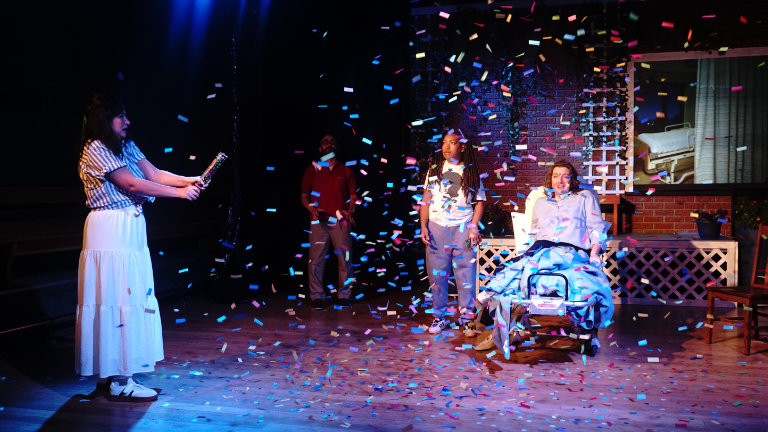
The production is now closed. It was presented in the Chapel of the Arts in Hope United Church of Christ, 6273 Eichelberger Street. Two rows of seating lined each of the chapel’s long walls. The action took place in the long, narrow space between the seats and on the raised area at one end of the chapel. The playwright designed the set and directed.
Choreographed episodes for one or more performers occasionally interrupted the action. The dancing in was evocative, but its relationship to the story was tenuous. The choreography was by Paige Van Nest; the music was by Zach Tesch. The torture and execution scenes were stylized but still tough to watch.
The cast was headed by Jade Cash, who admirably depicted Jane’s growth political growth in Act One and spiritual growth in Act Two. In order of appearance, the fine supporting cast included:
- Kathryn Pierce as young Jane Grey
- Heather Fehl as Frances Grey (Jane’s mother) and Anne Boleyn
- Ian McCreary as Henry Grey (Jane’s father), Father John, a guard, and an executioner
- Cece Mohr as Edward VI
- Nicholas Barrows as John Dudley, Henry VIII, a guard, Thomas Kyme, and an executioner
- Keira Quintana as Katherine Grey and Anne Askew
- Henry Schumacher as Guilford Dudley and a guard
- Colin Nichols as Wriothesley and a Protestant pastor
The creative team’s contributions included Chrissy Punzo’s costumes and props, Ramona Orior’s lighting, Grace Oliver’s dramaturgy, Keira Quintana’s set painting, and Levi Miller’s sound.
—Gerry Kowarsky
Photo by Alex Hankins
From the left, Heather Fehl as the ghost of Anne Boleyn, Jade Cash as Lady Jane Grey, and Keira Quintana as the ghost of Anne Askew in “The Queen and Her Ghosts.”