When the lights come up in Will Eno’s “Wakey, Wakey,” a man in pajama pants says, “Is it now? I thought I had more time.” This is a reasonable thing for an awakening man to say, but it is also a poignant reference to the speaker’s mortality. “We’re here to say good-bye,” he says later.
Meanings both on and beneath the surface, unpredictable tangents, half-finished thoughts, and gallows humor make “Wakey, Wakey” a challenging and fascinating play to watch in the excellent production by The Midnight Company.
The one speaking character for most of the play is called Guy in the script, but is that his name or a generic description of an everyman? From a wheelchair, he speaks directly to an audience, but is this audience in the theater or his mind? “This was originally going to be something else,” Guy says, adding “I don’t know what it is, now.” He has prepared index cards and a slide show with sound, but he is easily distracted and skips from one subject to another.
Guy is played by Joe Hanrahan, a past master at performing Eno monologues. He presented “Thom Pain (based on nothing)” in 2006 and 2016, and “Title and Deed” in 2017. Under Ellie Schwetye’s sensitive direction, Hanrahan commands attention in “Wakey, Wakey” with his ability to shift seamlessly between humor and pathos, his deep understanding of how an Eno narrator thinks, and the virtuosic timing needed to depict spontaneity.
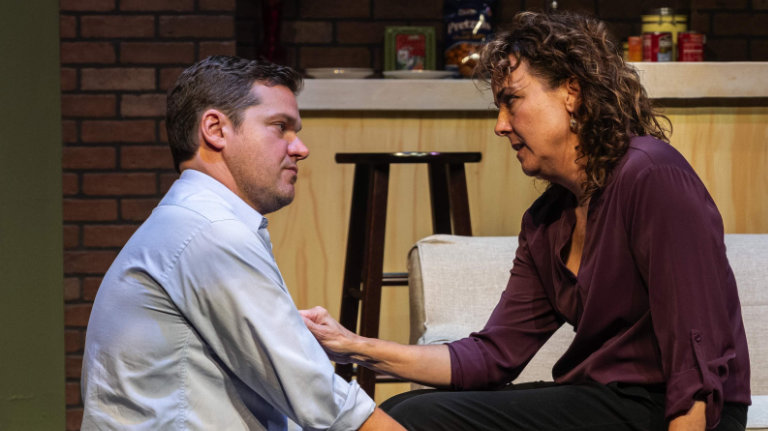
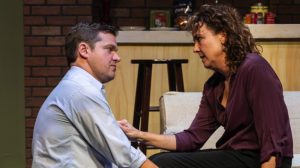
The situation in the play becomes clearer with the arrival of the second character, Lisa, who is looking after Guy. In Rachel Hank’s beautifully judged portrayal, Lisa is a concerned, totally professional caregiver who moves the play toward a deeply affecting conclusion.
The Midnight production showcases the fine work in Liz Henning’s costumes, Tony Anselmo’s lighting, Zac Grimm’s projections, and Ellie Schwetye’s sound.
“Wakey, Wakey” continues through August 1 at The Chapel, 6238 Alexander Drive.
—Gerry Kowarsky
Photo by Joey Rumpell
From the left, Rachel Hanks and Joe Hanrahan in “Wakey, Wakey.”