Great interpreters make a great work of art an even richer experience. Opera Theatre of Saint Louis’ brilliant production of “A Streetcar Named Desire” is the work of many great interpreters. At the top of the list is the composer, Andre Previn, whose music is a towering achievement.
Previn and librettist Philip Littell did not have the luxury of shaping the opera’s words to the music. The Tennessee Williams Estate required them to hew as closely as possible to the play’s text. Previn triumphs despite the restriction, drawing on the full range of his musical experience, including classical music, jazz, and film scoring.
I was continually amazed at how insightfully Previn’s music brings out the libretto’s emotions, from the tenderest to the most jarring. Because of the music, I gained a better understanding of the chemistry between Stanley Kowalski and his wife Stella and what Blanche Dubois saw in Stanley’s friend Mitch besides financial security.
The libretto’s most consequential words are the ones Blanche says to her husband after learning his secret. The music conveys how shattering those words must have been for her him to hear.
Daniela Candillari’s masterly conducting draws gorgeous playing from the St. Louis Symphony and brings out the extraordinary colors in Previn’s orchestration. Candillari’s incisive program note is required reading, as is the equally rewarding note by stage director Patricia Racette.
Her direction provides exactly want the Williams estate wanted— the same respect the text would receive in a staging of the original play. This production explores William’s characters as profoundly as any I have seen.
All four principals are superb in both their arias and their acting. Sara Gartland embodies Blanche’s painstakingly crafted façade and plumbs the guilt-ridden depths beneath it. David Adam Moor radiates the intimidating masculinity that makes Stanley so menacing. Lauren Snouffer’s portrayal of Stella establishes a sexual dependence on her husband that mirror’s the dependence on strangers with which her sister self-medicates. Bille Bruley is extraordinarily sympathetic as Mitch.
The exemplary supporting cast includes Ashlyn Brown as Eunice Hubbell, Landry Allen as Steve Hubbell, Cole Bellamy as Pablo, Edmond Rodriguez as the young collector, Rosaria Armas as the flower seller, Kim Stanish as the nurse, and Eric DeMario as the doctor.
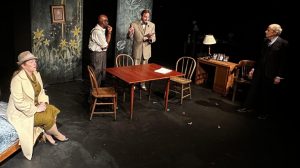
Andrew Boyce’s set design cleverly uses small differences in floor height to articulate spaces without interior walls. Placing the area curtained off for Blanche upstage prevents the curtain from interfering with sightlines. This arrangement works better on Opera Theatre’s thrust stage than a traditional New Orleans shotgun floorplan would.
The set’s pale rear walls have a ghostly quality and are an ideal background for the wonderful effects in Eric Southern’s lighting and Kylee Loera’s projections. The streetcar’s arrival is stunning moment.
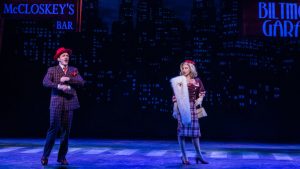
When sisters Blanche and Stella first see each other, they have strikingly contrasting looks thanks to Amanda Gladu’s costumes and Krystal Balleza and Will Vicari’s wig and makeup. Blanche’s appearance is polished; Stella’s is without artifice.
The action onstage is impactfully staged by choreographer Seán Curran, fight choreographer Shaun Sheley, and intimacy coordinator Delaney Piggins. The work of English diction specialist Ellen Rissinger pays dividends throughout.
“A Streetcar Named Desire” continues through June 26 at the Loretto-Hilton Center, 130 Edgar Road.
—Gerry Kowarsky
Photo © 2026 by Eric Woolsey
Foreground to background: Lauren Snouffer as Stella, Sara Gartland as Blanche, and David Adam Moore as Stanley in “A Streetcar Named Desire.”