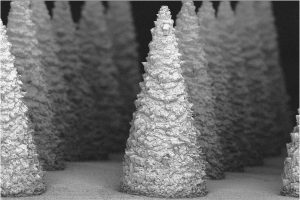
New research from the lab of Srikanth Singamaneni, the Lilyan & E. Lisle Hughes Professor in the Department of Mechanical Engineering & Materials Science, shows the early success of a microneedle patch that can be applied on the skin to quickly and safely capture biomarkers from the biofluid in the skin, or dermal interstitial fluid, and quantify them accurately on the patch. The patch detected early signs of kidney injury and may one day support home or point-of-care monitoring without requiring refrigeration.
Kidney disease is silent in its early stages, progressing without symptoms until the disease is advanced. Researchers in Singamaneni’s WashU lab, in collaboration with researchers at Texas A&M University and Washington University School of Medicine, have been developing the minimally invasive method to improve diagnosis in earlier stages.
In the new research, the microneedle-based sensors, shaped like traffic cones, penetrate only the outer layers of skin, which avoids pain, bleeding and the need for trained personnel to use them. Adding metal-organic frameworks to the microneedles stabilizes the biomolecules in high-heat settings.
The next steps are to adapt the microneedle method to other proteins, metabolites and nucleic acids to broaden its scope of diagnostics for other diseases and medical conditions.